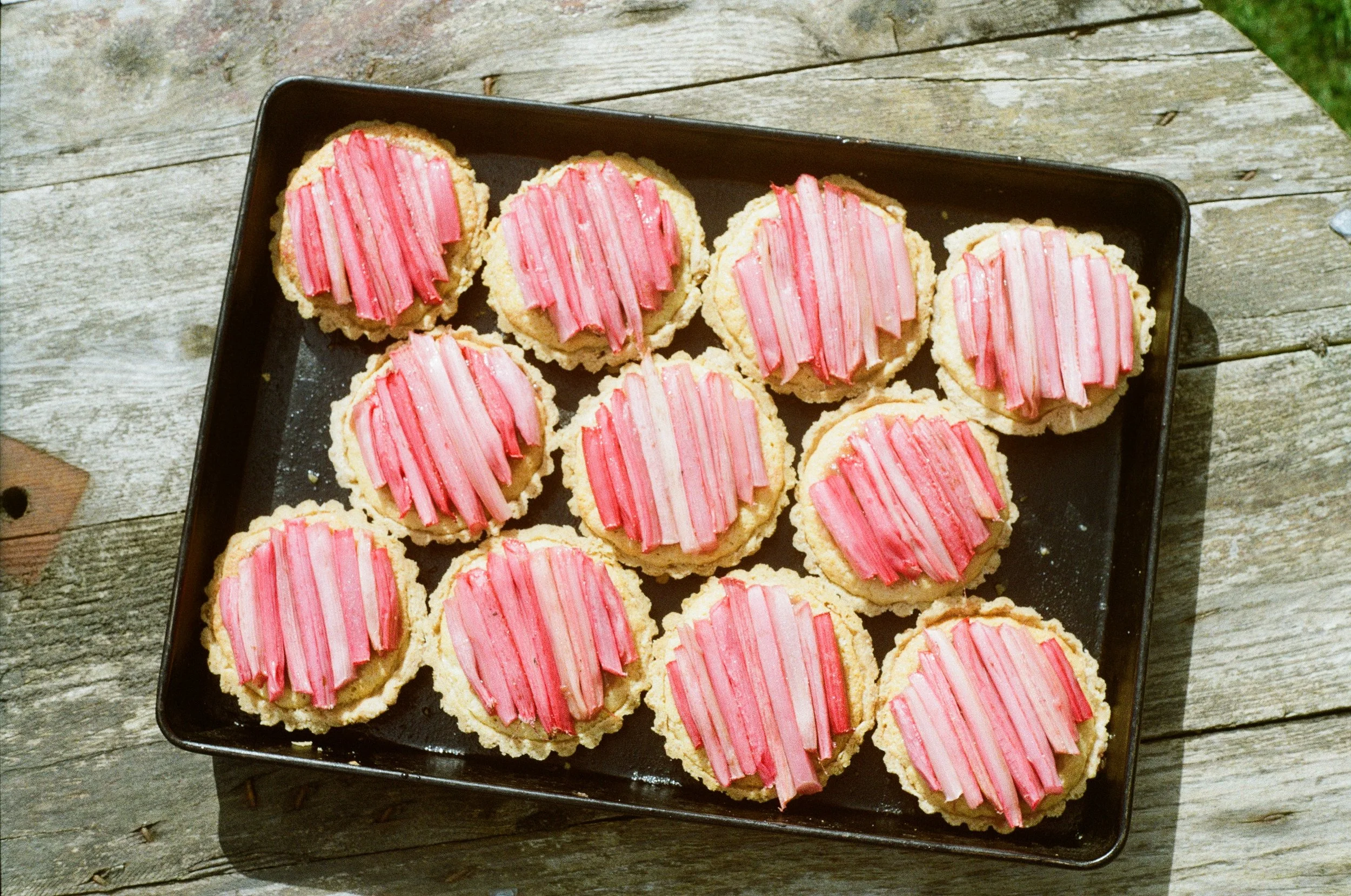
Yorkshire Forced Rhubarb
Pink to make the boys wink via Blue Apron
by Katie Hourigan, our Head Chef & previously our Head Baker
Mar 09, 2026
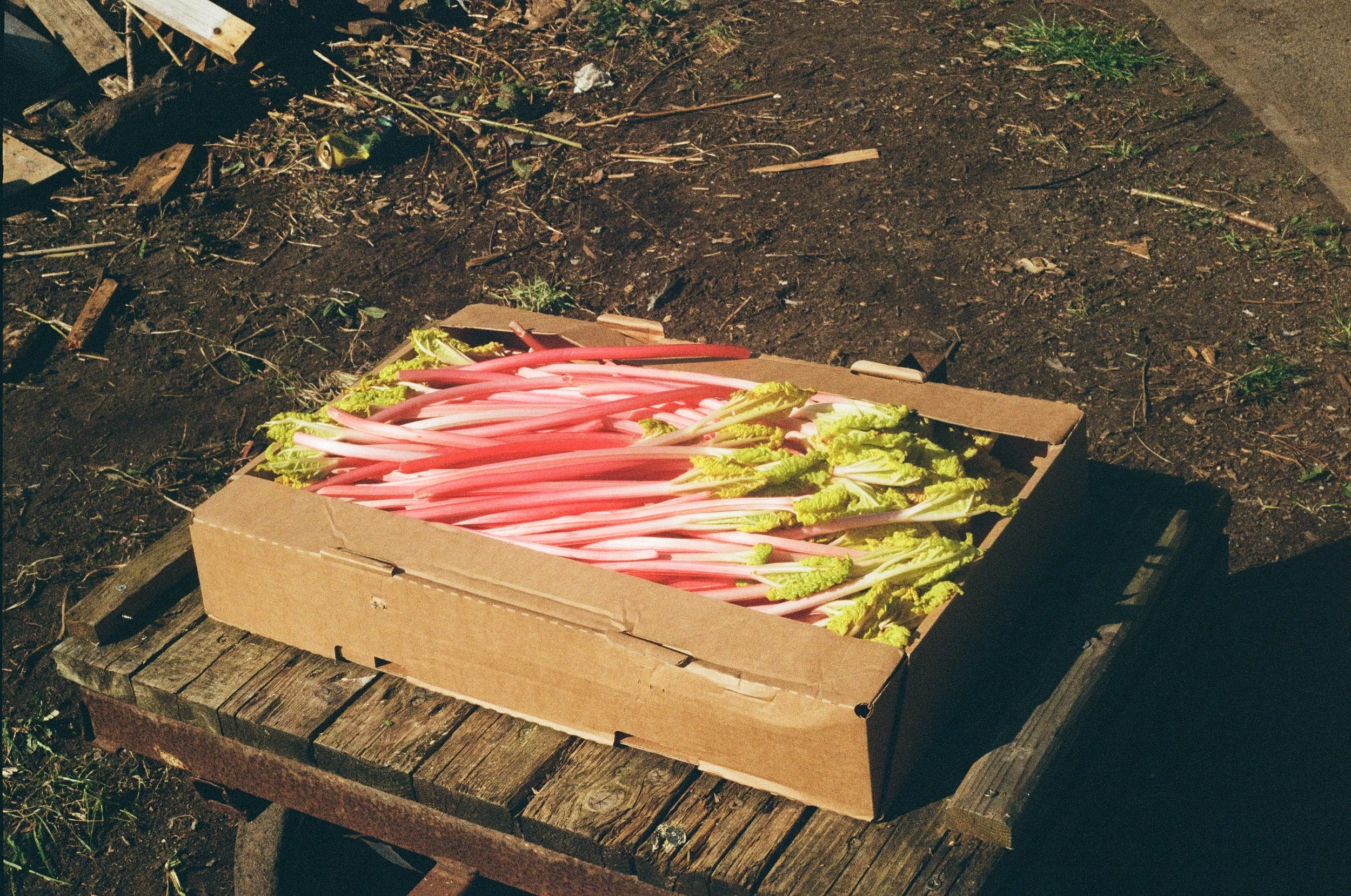
It is the third year in a row that I place an order of forced Yorkshire rhubarb with E. Olroyd & Sons. The six kilogram box arrives like a Christmas present in the post, its red and yellow cardboard slightly soft and bulging from the damp air. I order Class 2, the cheapest grade - thin spindles of sticks, less likely to leach out moisture into a sponge or tart, than their thicker stemmed counterparts.
The rhubarb is grown within the Rhubarb Triangle, a 9-square-mile area of West Yorkshire, at the foot of the Pennines. This triangle lies in what is known as a ‘frost pocket’ - an area whereby a low-lying dip or hollow in the landscape causes cold, dense air to settle and pool at night. As rhubarb is native to Siberia and Western China, it is this micro-climate of cold and damp that enables the plant to thrive.
At Platt Fields, where our own rhubarb patch is still resembling stubs, the forced stuff has a language and mythology of its own. Facts about are traded by volunteers: ‘It’s grown in the dark / picked by candlelight / it’s a vegetable, not a fruit / a relative of buckwheat, I’ve heard / feed it spent coffee grounds / it’s poisonous raw / no it’s not / only the leaves’.
But what does it actually mean for rhubarb to be forced? After growing outside for an initial two years, the forcing takes place when the stems are moved into large sheds, to continue their growth in complete darkness. In the dark, the stalks are forced to grow at an accelerated rate; up to an inch a day, straining for the light. Mike says they grow so quickly you can hear the stalks popping, creaking.
Depriving the plants of light in this way also prevents photosynthesis, and blocks the production of chlorophyll, the pigment that makes plants so green. Instead, I learn, pigments called anthocyanins (the same compounds that make blueberries blue or red cabbage red) are left to dominate. This is not a process of ripening, of waiting for a red blush to appear. The sticks emerge in this way, fluorescent, not in spite of the darkness of winter, but because of it.
*
I plan to bring the whole package with me, to the sheltered housing down the road from the garden, where I have been running cooking workshops with a small group of residents for the past 12 weeks. I plan to only use a handful of sticks, but want to retain a bit of theatre about the process. There will be a drama in the unboxing, cutting the thick brown tape with a blade, revealing the long and elegant stems, neatly packed, serene and candle-like.
I am hopeful that one resident in particular will enjoy the process. Tara has hot pink hair and hot pink nails that she gets painted every Friday at the pamper session run by the housing scheme. She wears a pink cardigan, and occasionally glues pink glitter into the roots of her hair. Of all the residents that come to the sessions, Tara’s needs are the most complex. She is elderly, more so than many of the other residents, and has Alzheimer’s, meaning her moods can shift quickly. In moments of distress, Tara’s hands shake, and she can become anxious, paranoid that the aches and pains of old age are symptoms of cancers. Her mood greatly affects the feel of the sessions. On days where Tara is well, chirpy and bright, there is a kind of buoyancy in the room. The group tell Tara she is looking gorgeous. They tease each other for being fussy, for not liking certain spices, for eating too many biscuits. There is often singing, ‘Oh lets twist-again - like we did last summer’. In turn, on the days where Tara is a little disorientated or tired, the atmosphere is weighted. I can begin to feel a little ridiculous in trying to continue a session, making shortbread or chutney as though nothing is wrong. I feel out of my depth. I will bring Tara another cup of weak tea, no sugar.
With this in mind, I had hoped that the glamour of the pink rhubarb, a box full of Tara’s very favourite colour, might tip the balance of her mood. We open the box. ‘Look Tara, it matches your hair!’ I say, ‘Pink to make the boys wink!’ This is her mantra, repeated week after week by her fellow residents and carers. ‘No it doesn’t!’ she says adamantly. Today, pink does not make the boys wink.
Tara doesn’t like rhubarb, and nor does Karima. But other residents think of it more fondly. Memories circle the room, of mothers that grew rhubarb in back gardens, mothers making jams and wines at home in Salford. We set to work. Sitting in a circle in the low armchairs of the common area, we work through the bulk of fruit, cutting the stems with our blue handled knives. The carers assist Tara, their gold rings flashing. The group is miffed at the quantity of fruit there is to get through,‘You‘ve put us to work!‘,they say, but soon settle into the rhythm of the task. We are left with mounds of small pink sticks, an inch or two long, and smaller bowls of the frilly pale green tips, that I will bring back to the garden to compost.
We toss a few handfuls of fruit with sugar, and the zest and juice of an orange to create the base of a crumble. I ask Angela to breadcrumb the butter and flour together for the topping. ‘This reminds me of Ireland’ she says, nodding to her hands, the back and forth of thumb and forefinger. Over the weeks I have set Angela the task of crumbing flour and butter for all sorts - a damson crumble in October, a buttermilk soda bread, scones. It is a task she enjoys, and is good at. She sprinkles the pale sandy mixture over the fruit.
On a separate tray for Karima and Tara, I press a handful of the crumble mixture into a flat disc on a piece of baking parchment, and set a timer for 10 minutes, hoping that it will emerge from the oven as a slightly knobbly shortbread. Once the crumb just starts to brown at the edges, I pull the tray, and try a piece of the corner. It is delicious - hot and salty and rich with butter. We eat the rhubarb and non-rhubarb crumble with cups of tea and a small drizzle of cream. I wash the bowls, and bring the crates back to the garden.
*
The conversations we had over the session were a reminder that it was not so long ago that in England, even in inner city Salford, the act of growing your own rhubarb, and using it to make jam or wine or a crumble, was a very ordinary activity. This way of life was not reserved for a certain type of person - a chef or a baker or an organic-homestead type. People lucky enough to have access to gardens simply grew their own food, and cooked it, often out of necessity.
I won’t be telling you how to make the perfect rhubarb compote, or crumble, or custard tart (Nicola Lamb is your woman here). But if you get the chance to buy a couple of sticks of rhubarb in the coming weeks, the sight of them poking out the back of your rucksack, or lying still on the countertop, is likely to cheer you no end.