
Folk, Food, Ecology, and Contemporary Urban Community
In January we were one of the recipients of the Ffern Folk Foundation grant. We recently did an interview with Ffern, talking all about the project, why we are interested in folk practices, and what it’s got to do with food systems, environmental regeneration, and building communities. We got a bit carried away discussing all these ideas and what connects them, so the version that was published on Ffern’s website had to be significantly redacted, but we still wanted to share with you all some of the full answers here:
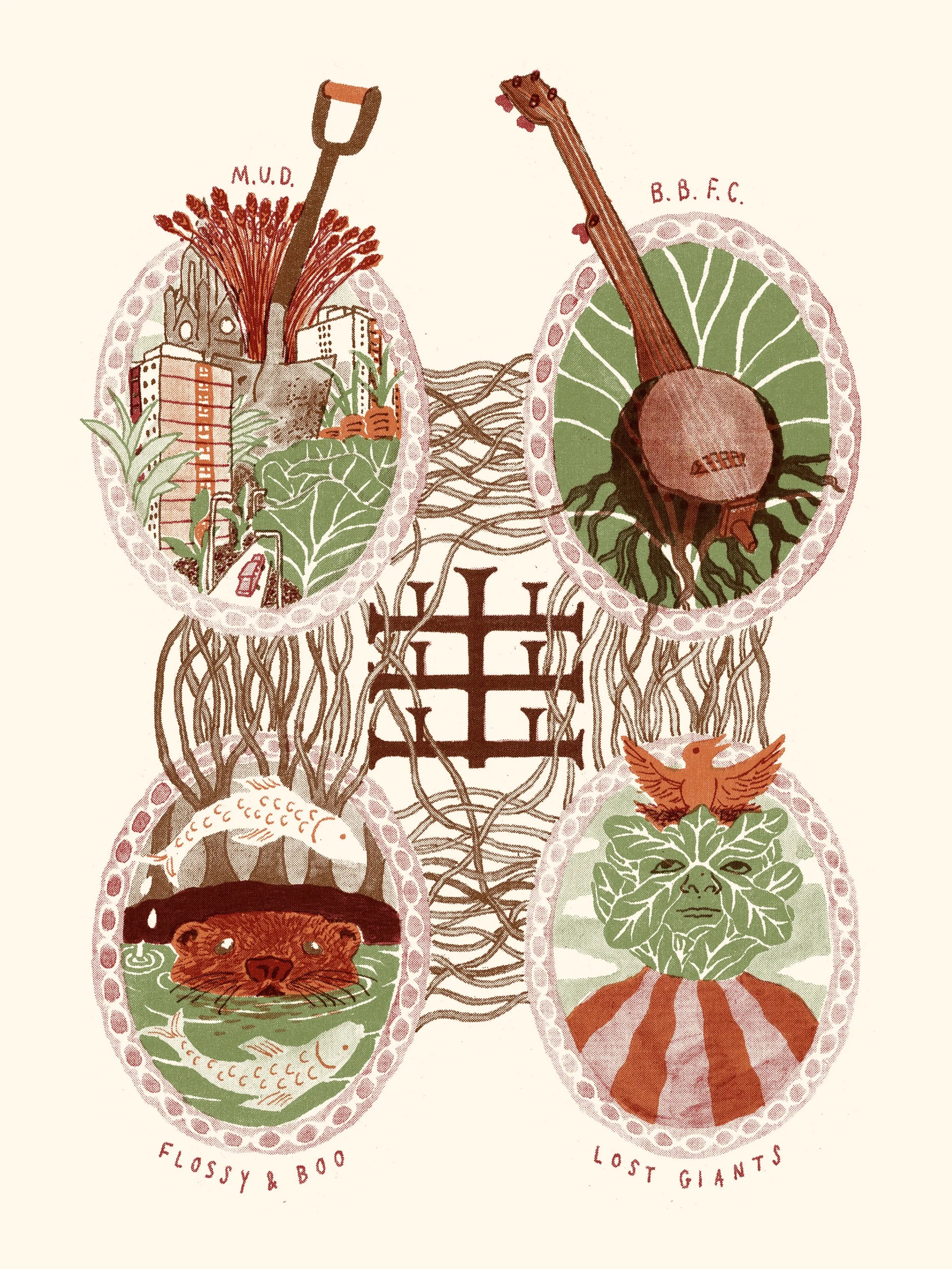
Artwork created by @willpowersmakes
Your full name is ‘Manchester Urban Diggers’. Can you explain how that came about?
In 2019 we [directors, Sam, Jo and Mike] sat down in our kitchen and set aside a day to give ourselves a name (and it did take all day…)! We landed on a Manchester Urban Diggers, partly because of the convenient acronym, and partly as a reference to the Diggers (or True Levellers), a group of ordinary people who, in 1649, began to grow vegetables on common land at St George’s Hill in Weybridge, Surrey. They were ordinary people, asserting their rights to feed themselves and to work the land in common, in the face of high food prices and the increasing enclosure of common land by large aristocratic estates.
We realised that it is still extremely difficult to access land in the UK if you don’t inherit it, and that there are no obvious pathways to do so, particularly when you grow up in a city. The reasons for this go right back to the early land enclosures which the Diggers were protesting against, and even further back to the Norman Conquest. The reference to the Diggers, whose leader Gerard Winstanley came from Wigan, only down the road from us, helps us to make these connections, as we think about how ordinary people can create a fairer, more sustainable system of food production. Sam has written more about all of this on a blog here.
What do you hope to achieve with the support of the Ffern Folk Foundation?
The basic plan is to run two large community events, built around folk arts and practices which connect to nature, ecology, food growing, the movement of the seasons, as a great many of them do. These will be planned by members of our community, through workshops, bringing in artists, storytellers and practitioners, to work with community members to share and explore the different folk traditions that make up their heritages, and to develop ideas about the ways in which people would like to celebrate them together. But these events are really the means, rather than the end. The idea behind this is to create space for people to begin to develop shared rituals, art, stories, for the place and community we’re in now, and into the future.
We believe folk practices, stories, art and music, are rooted in the places we’re in, their communities, ecology and seasonality; they can be a kind of inter-generational, vernacular ecological knowledge, and narratives that bind us together. British folk traditions such the wassail, which we celebrate every January in our community gardens and orchards, grow out of and speak to the culture, life, and work of ordinary people on the land in the cider-producing regions of England; these kinds of connections between folk ritual and specificity of place, ecological conditions and food practices are important. But we are based in Manchester, under rapidly changing ecological conditions, in a community made up of people whose heritages stretch out across the whole world, where most people don’t live in close connection with the land.
Recognising folk practice as a living, evolving activity, made by people in community with one another, we wish to bring British folk practices into close contact with those originating from the many other places and cultures represented by people in our community. We wish to support people to understand and share these traditions, to connect to past, present, and future, and to use these connected practices to develop new shared stories, to build a cohesive, rooted community, connected to one another in commonality and difference. We wish also to use these practices, in connection to the space and work of our community gardens, to support people to build a stronger understanding of and connection to local ecology, seasonality, food growing, which can equip them (us!) to collectively face the unfolding climate crisis.
Your proposal to the Foundation focuses on two large events, one in the Spring, and one in the Autumn. Why are these times of year particularly important to you and the communities you serve?
We have planned these events around the start and end of the core food growing season where we are. This is firstly about connecting people to sustainable food growing practices, based around locality, seasonality and ecological-regeneration, which is central to all of our work.
We have a track record of running some of our largest community events at these times. We celebrate Spring and the start of the growing season with May Day, with Maypole dancing, seed sowing, crowns and a Jack-in-the-Green made from soft, freshly cut willow; we have also often celebrated Nowruz, a Persian New Year festival which coincides with the Spring Equinox. We celebrate the Harvest, or Mabon festival, with apple pressing, an allotment show, food over the fire, and music and dance, of course; we often run pumpkin carving workshops ahead of Halloween, with the seasonal glut of pumpkins (though really swedes would be more regionally appropriate). These celebrations mark key turning points in our food-growing calendar.
The other important thing about these times of year is that, at least in the Northern Hemisphere, their connection to the turning of the seasons and the planting or harvesting of food makes them of wide cross-cultural relevance. The folk traditions of many places and cultures include Spring and Harvest festivals, so we hope these can become shared seasonal reference points across our community.
You empower your local communities to take ownership of your projects from root to fruit. Can you dwell on the importance of this, particularly within the context of inner-city Britain?
This is so important to us, and always has been, from when we first started as a small group of volunteers working together to grow food on half of an old bowling green. We don’t want to do things for people, but to work together, in community.
We often work with people in our immediate communities who experience social isolation - particularly high among e.g. older people, students, and other new arrivals to the area, including people seeking asylum. Social isolation and fragmentation of our communities is exacerbated by the increasing privatisation of contemporary UK cities, and the loss of shared community spaces. This in turn, the loss of public assets - shared places such as youth clubs, community centres, libraries, where people can come together, without needing to spend money - is partly a result of regionally uneven spending cuts. In the 2010s, the North West faced 29% spending cuts per person, the largest in the UK outside London. (The British countryside is also highly privatised, or enclosed, and still increasingly so, but that’s a slightly different story).
Without these spaces, it is increasingly hard for people to form meaningful communities. This can leave individuals isolated, lonely, spiritually unfulfilled, and at a wider level, increases division, fragmentation, scapegoating of marginalised groups. We believe that creating spaces that are really shared, where everyone in the community can take common ownership, through working in collaboration with one another, are essential for creating inclusive, open communities where people feel that they really belong, where we can get to know each other, and practice the essential skills of collectively taking care of one another and the spaces we share, as well as the non-human natural world upon which we all depend.
This is also connected to folk culture, right - to art, music, stories and rituals which are made by and for the communities who practice them. These practices are not owned by anyone, but are composed often anonymously, altered through many hands, on many tongues, sometimes over generations. A folk song may be beautiful on record, but it truly comes to life in the moment of singing together, in the living room, pub, or round the garden fire. This is about ordinary people coming together, being nourished through common activity, which cannot be owned, whose value cannot be extracted from it, just as our gardens work towards a vision of food sovereignty which opposed the treatment of land and what grows on it as merely commodities to be industrially extracted to enrich a small few, and sees it instead as a common treasury for all the life that lives on it.
The strength in diversity that is found within Britain’s cities is of a huge benefit to Britain’s cultural footprint. Yet the image of access to ‘folk’ and nature tends to be monocultural. This is changing, but what more do you think needs to be done?
Absolutely more needs to be done to address this.
This is partly about opening up our conception of what ‘folk’ even is. It is not a particular set of aesthetics or practices - an ossified vision of the genuine folk traditions which emerged in the British Isles under earlier historical and cultural conditions. And the traditions of this archipelago have anyway actually been practiced by a wider range of people than is sometimes acknowledged, as we see in e.g. the amazing archival work of Angeline Morrison around Black voices in British folk song, or the huge influence of Traveller singers on our folk songs and music.
Folk is, really, about the ongoing, living traditions of art, music and practice that ordinary people make together - regardless of who they are or what that looks like. As Lucy Wright says in her ‘Folk is a Feminist Issue’ Manifesta, “Folk is the stuff we make, do and think for ourselves”.
All global cultures have their own folk traditions, with distinct but also overlapping and mutually influencing aesthetics. I think about the similarity between my Irish bodhran and the Kurdish daf - both simple frame drums, both often played in our garden, sometimes together. Indeed, globally many peoples have much stronger connections to their folk cultures than we do in England (this, too, is perhaps related to the early enclosure of much of our common land!). And all the people in these isles have a right to engage with the folk practices that have emerged here, and to keep those practices alive by adapting them, making them their own.
Those of us who make, practice, promote folk arts and traditions need to open up our understanding of what folk is, to recognise it as that vital interchange between ordinary people, not owned or authorised by any particular people or group, and to put that belief into practice in the spaces that we occupy, whether that’s curating a festival or organising a session in a pub back room.
In our work, we see how this is all connected to access to land! And a feeling of not only being welcome (or sometimes even allowed) in a space, but feeling safe and seen and respected. We’ll end with a little story which exemplifies this, from Cara, our Events Manager, and co-founder of the Queer Roots Collective - a grassroots not-for-profit that grew out of Platt Fields Market Garden in 2022, who work to shift the focus of pride to community rather than capitalist cooperations.
“When we asked the MUD Directors about hosting our first Alternative Pride event in the garden, the response we got was ‘It’s not my garden, it’s our garden!’ On the first evening of the event, under a gorgeous setting September sun, a folk session, Queer As Folk, was born amongst the veg beds - this has run every other week since. And from that session, an inclusive Morris Side, Roots Morris, was born. One yes, back in 2023 has created a mycelial network of inclusive spaces and places that warmly invite those who face additional barriers to access the outdoors and more traditional ‘folk’ spaces. It has also created links between musicians, creatives, and makers across the city. These links forged friendships, solidarity networks, and creative projects and partnerships. Having access to spaces to be truly yourself, to exist as your most authentic, whole self helps you to connect those parts of ourselves to others. They allow stories to be told and songs to be shared (and written!) about what it is to exist in the here and now as ourselves. If that isn’t ‘folk’, I don’t know what is.”